
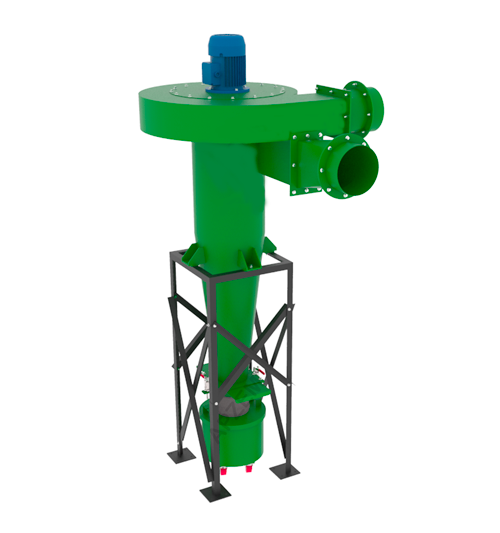
Cyclone dust collector
Cyclone dust collector is the most widely used dust collection equipment in various types of industries and it is the best choice for industrial dust control. Cyclone Dust Collector is widely used because it is the most inexpensive industrial dust collection system puts of industry experience to work to produce a new, best-in-class dust collector capable of reducing equipment size and number of required filters by up to 40% compared to a typical cartridge collector. A smaller collector helps lower the initial purchase price, reduces filter replacement costs, and opens up valuable manufacturing floor space.
Description
Cyclone dust collector is the most widely used dust collection equipment in various types of industries and it is the best choice for industrial dust control. Cyclone Dust Collector is widely used because it is the most inexpensive industrial dust collection system puts of industry experience to work to produce a new, best-in-class dust collector capable of reducing equipment size and number of required filters by up to 40% compared to a typical cartridge collector. A smaller collector helps lower the initial purchase price, reduces filter replacement costs, and opens up valuable manufacturing floor space.
cyclone dust collector put wide industry experience to work to produce a new, best in standard dust collector capable of reducing equipment size and number of required filter bags by up to 80% compared to a cartridge collector which captures 99.98% of all wood chips and dust particles that enter the
Cyclone Dust Collector. Centrifugal force drops particles of all sizes out of the air stream – everything from chips to microscopic particles. A dust bin positioned underneath the funnel captures the dust and chips in a trash container. Air flows in a helical pattern, beginning at the top (wide end) of the cyclone and ending at the bottom (narrow) end before exiting the cyclone in a straight stream through the centre of the cyclone and out the top. Larger (denser) particles in the rotating stream have too much inertia to follow the tight curve of the stream, and strike the outside wall, then fall to the bottom of the cyclone where they can be removed. In a conical system, as the rotating flow moves towards the narrow end of the cyclone, the rotational radius of the stream is reduced, thus separating smaller and smaller particles.